When the Water Came: How a Teenager’s Death Exposed the Growing Human Cost of Flooding in Nigeria’s Rivers State.
By Onyekachi Nwosu
Weeks before floodwaters swallowed homes across parts of Rivers State in southern Nigeria, the country’s weather agency warned that the state faced an elevated risk of severe flooding during the peak of the rainy season. The prediction proved tragically accurate.
Across flood-hit communities, families abandoned their homes, businesses shut down, farmers watched crops disappear beneath rising water and entire neighbourhoods struggled to recover from another season of destruction.
Among those counting the cost is one family in Oyigbo Local Government Area whose loss has come to symbolize the human consequences of a disaster many residents believe was not entirely unavoidable.
Through visits to affected communities and interviews with victims, farmers, environmental experts and government officials, this report examines how climate change, rapid urban growth and inadequate drainage infrastructure are combining to make seasonal flooding increasingly devastating—and asks whether earlier action could have prevented another tragedy.
A Promise That Came Too Late
The mechanic workshop was unusually quiet.
Customers came and went while the familiar rhythm of hammers striking metal echoed through the open shed. Engines were dismantled. Mechanics shouted instructions across the workshop floor. Life continued much as it always had.
But for Okey Osuji, the noise provided little comfort.
Nine days earlier, he had buried his only son.
The workshop had become more than a place of work. It was somewhere to escape the silence waiting for him at home.
“If I stay in the house,” he said softly, staring at the floor before continuing, “I keep thinking about him. I was afraid the loneliness would affect my health. That is why I came here—to keep myself busy.”
Every sentence seemed to demand enormous effort.
Sometimes he stopped speaking altogether.
Other times he struggled to hold back tears.
On July 17, 2026, his 17-year-old son, Ifeanyichukwu Osuji, drowned after floodwater overwhelmed Graceland Community in Oyigbo Local Government Area of Rivers State.
His death has become one of the clearest symbols of the growing human cost of flooding across the oil-rich Niger Delta, where increasingly intense rainfall collides with poor drainage, rapid urban expansion and inadequate flood-control infrastructure.
For Okey Osuji, however, it is simply the day his family changed forever.
The Decision That Changed Everything
Days of relentless rainfall had already forced the Osuji family to abandon their home.
Like many of their neighbours, they gathered a few belongings and sought temporary shelter elsewhere after floodwater invaded their compound and cut off access to surrounding streets.
In the confusion of leaving, Ifeanyichukwu realised he had left some clothes behind.
He wanted to return.
His father immediately objected.
“There was no need,” Osuji recalled telling him.
“I said his mother would travel to Aba and buy him new clothes.”
To the father, replacing clothes seemed insignificant compared with keeping his son safe.
But the teenager remained determined.
He returned to the flooded house with his mother.
Concerned by the depth of the water, he reportedly asked her to wait at a safer location while he entered the compound alone to retrieve his belongings.
It was the last time she saw him alive.
As he tried to make his way through the murky floodwater, he suddenly slipped beneath the surface.
His mother screamed.
Neighbours rushed towards the compound but stopped at the water’s edge.
No one was willing to enter.
The flood was deeper than it appeared, and residents feared anyone attempting a rescue could also disappear beneath the water.
Some searched desperately for ropes.
Others shouted instructions from nearby roads.
Nothing worked.
By the time Okey Osuji arrived after receiving the distress call, local divers had already been contacted.
When they finally recovered his son’s body, hope had already disappeared.
The SS3 student was dead.
Living With an Empty Space
Throughout the interview, Osuji repeatedly paused to compose himself.
His son, he said, was respectful, hardworking and full of dreams.
“He was my only son.”
The sentence hung heavily in the air.
Little else needed to be said.
Returning to work, he explained, was not a sign that he had begun recovering.
It was simply his way of surviving.
Every room inside the family home reminded him of the child he had lost.
The workshop, noisy as it was, offered temporary relief from memories that had become impossible to escape.
Yet grief is only part of the story.
According to Osuji, another child—a 13-year-old girl—also died in floodwater in the same community about two years earlier.
Residents say little changed after that tragedy.
Drainage problems remained.
Flooding returned.
Another young life was lost.
“I don’t want another family to pass through what we are passing through,” he said quietly.
A Disaster Measured Beyond One Family
The death of Ifeanyichukwu Osuji is perhaps the most heartbreaking consequence of this year’s flooding in Rivers State.
It is far from the only one.
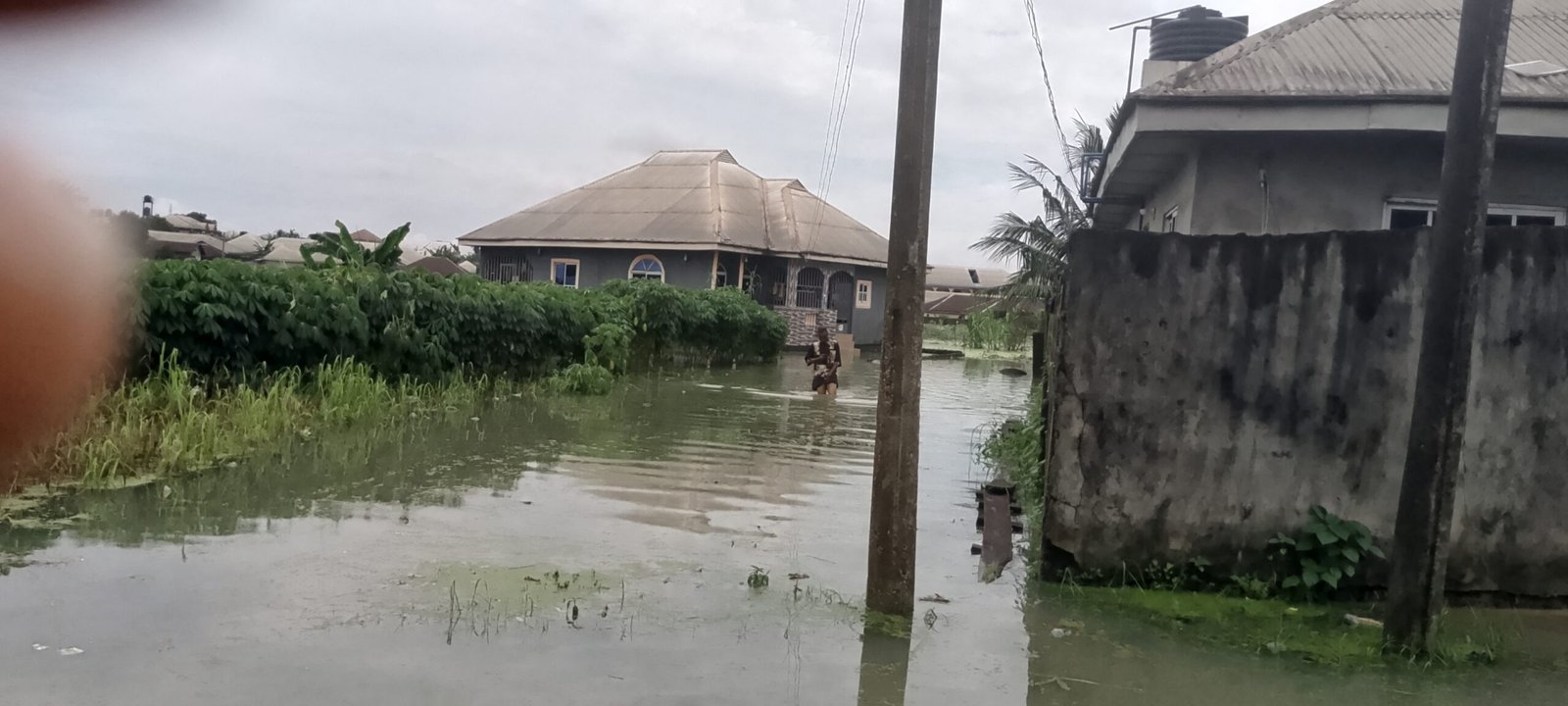
When this reporter visited Graceland Community, floodwater still occupied parts of residential streets.
Community leaders said more than ten homes were affected, while at least five families temporarily abandoned their houses after rising water made them unsafe.
Furniture lay outside under the afternoon sun.
Mattresses leaned against compound walls.
Children’s school bags, cooking utensils and household belongings were spread across open spaces in desperate attempts to dry before the next rainfall.
Several shops remained closed.
Some residents had already relocated.
Others stayed behind because they had nowhere else to go.
One widow stood quietly outside what had once been both her home and her small shop.
Within days, the flood had taken both.
Without the business that supported her family, she said she now depends largely on neighbours and relatives for survival.
“I don’t even know where to begin again,” she said.
Around her, residents shared similar stories of interrupted livelihoods, damaged property and uncertain futures.
Many insisted they no longer wanted to see government officials arrive only after disasters with bags of rice and emergency relief.
What they wanted instead were functioning drainage systems, cleared waterways and flood-control projects capable of preventing communities from going underwater every rainy season.
As one community leader put it:
“Preventing the flood is better than bringing relief after people have already lost everything.”
The farther one moves from the Osuji family’s compound, the clearer it becomes that their tragedy is not an isolated one.
Across Oyigbo Local Government Area, floodwater has altered daily life in ways residents say have become painfully familiar.
Roads that once connected neighbourhoods now resemble shallow streams after heavy rainfall. Children wade barefoot through muddy water on their way to nearby streets. Motorists inch cautiously through flooded roads, unable to tell where potholes end and floodwater begins.
For many families, every downpour now brings the same question:
Will our homes still be dry tomorrow morning?
That uncertainty has become part of life for many residents.
Communities Slowly Going Under
In neighbouring Umundina Community, the destruction was equally visible.
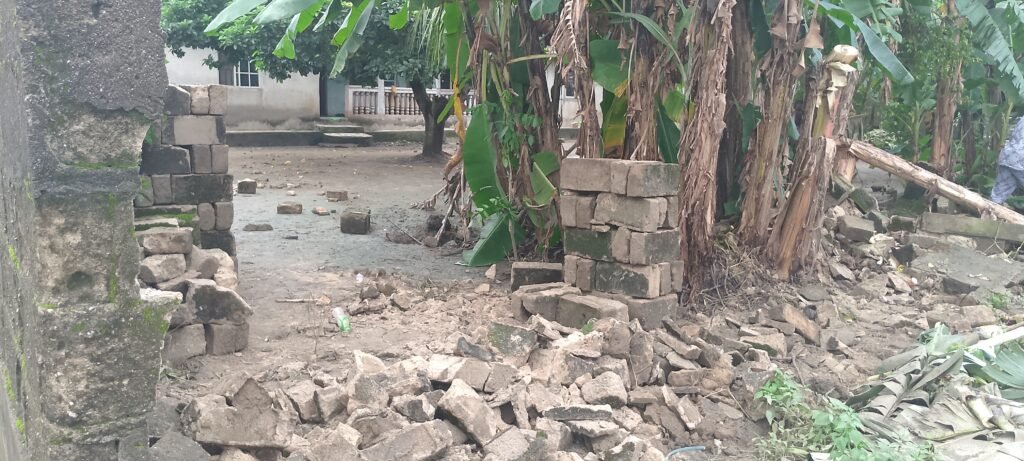
Residents said about fifteen homes were affected during the latest flooding, while three residential compounds lost their perimeter fences after days of relentless rain.
When this reporter visited the community, soaked mattresses, pillows and household furniture covered open spaces as families struggled to salvage whatever the flood had spared.
Doors and windows remained wide open to dry damp rooms.
Some compounds had been abandoned altogether.
Others still bore the muddy watermark left behind by receding floodwater.
Chief Ezekiel Iwela, the community’s traditional ruler, described the flooding as one of the worst the area had experienced in recent years.
According to him, many families have suffered financial losses from which they may never fully recover.
Nearby, landlord Vincent Eloka stood quietly beside the collapsed perimeter fence surrounding his property.
The structure had given way under the pressure of the floodwater.
Repairing it, he admitted, would not be easy.
Like many residents, he said he was already struggling with rising living costs before the flood struck.
Now rebuilding his home has become another burden.
Just beyond Umundina lies Umu-Ebeleke Community.
Residents there described flooding that affected almost every household, forcing many families to move valuables onto beds, tables and elevated platforms as muddy water crept through their homes.
Several roads became difficult to access.
Small businesses shut their doors.
For many residents, seasonal flooding has ceased to be an occasional disruption.
It has become a way of life.
Residents Want More Than Relief
Across the affected communities, one message was repeated with remarkable consistency.
People no longer want to rebuild after every rainy season.
They want to stop rebuilding altogether.
Residents acknowledged receiving relief materials during previous floods but argued that emergency assistance has done little to address the causes of the problem.
“What we need,” one community leader said, “is not another truck bringing food after the flood. We need proper drainage before the rain comes.”
Others echoed the same concern.
They called for blocked canals to be cleared before the rainy season, stricter enforcement of planning regulations and sustained investment in drainage infrastructure capable of serving rapidly expanding communities.
To many residents, prevention has become more valuable than relief.
Warnings From the Orashi Region
Although some communities in the neighbouring Orashi region have not yet experienced flooding on the same scale this year, anxiety is growing.
Emeni Ibe, President General of the Orashi National Congress, believes the worst may still lie ahead.
According to him, many canals that once carried excess rainwater have become blocked over time, preventing water from flowing naturally during periods of heavy rainfall.
Unless those waterways are cleared quickly, he warned, more communities could experience flooding before the rainy season ends.
He urged the Rivers State Government to deploy swamp buggies to desilt major canals and appealed to the Federal Government to support flood prevention efforts before more lives and property are lost.
His concerns mirror those expressed by residents in Oyigbo.
Across Rivers State, many believe governments spend far more responding to disasters than preventing them.
When the Flood Reaches the Farm
For many Rivers residents, the flood is no longer confined to homes and neighbourhoods.
It is beginning to threaten something even more fundamental.
Food.
In Kunusha Community in Ahoada West Local Government Area, cassava farmer Chief Enoch Egbo walked through farmland already showing signs of prolonged waterlogging.
According to him, cassava stems begin to rot when left too long in saturated soil, while exposed roots gradually decay beneath the surface.
“If we don’t harvest early,” he said, “we lose everything.”
Egbo believes many rural farmers still receive little guidance on practical ways to reduce flood damage despite repeated warnings about severe rainfall.
He also expressed disappointment that communities expected to feed much of the state receive limited technical support before disasters occur.
In Oyigbo, farmer Obinna Ejiofor said many cassava and yam growers have already begun harvesting earlier than planned because of persistent rainfall.
Harvesting early, however, comes at a cost.
Immature crops often sell for lower prices, reducing farmers’ incomes while affecting food supplies later in the season.
Ejiofor believes government intervention should go beyond distributing relief materials after disasters.
He suggested programmes that would enable authorities to purchase surplus produce from farmers forced into early harvesting, helping them recover some of their investment while strengthening food security.
Agricultural economist Dr. Samuel Nwokugha of the University of Port Harcourt said changing weather patterns mean farmers can no longer rely solely on traditional planting calendars.
Instead, he said, climate information should become an essential farming tool.
By monitoring seasonal forecasts, improving drainage around farmlands where possible and adjusting planting schedules, farmers can reduce some of the risks posed by increasingly unpredictable rainfall.
Yet even he acknowledges that adaptation has limits.
When floodwater remains for days, crops such as cassava, yam and vegetables grown in low-lying communities remain especially vulnerable.
The consequences, he warned, extend beyond individual farms.
If flooding continues to destroy agricultural production across Rivers State, the effects will eventually be felt in household incomes, local markets and food prices.
As communities struggle to recover from the floods already experienced, another question is becoming increasingly difficult to ignore.
Could more of this damage have been prevented?
That question leads directly to warnings issued months before the rains intensified—and to growing scrutiny over whether authorities did enough after they were warned.
The warnings came months before the tragedy.
When the Nigerian Meteorological Agency (NiMet) released its 2026 Seasonal Climate Prediction, Rivers State was identified as one of several states expected to experience above-normal rainfall between July and September. The agency warned that low-lying and coastal communities faced an increased risk of severe flooding and urged governments, emergency agencies, farmers and residents to prepare before the rains reached their peak.
For people living in Graceland, Umundina and Umu-Ebeleke, those forecasts are no longer viewed as scientific projections.
They have become lived experience.
The flooded streets, damaged homes and shattered livelihoods seen across Oyigbo this year closely mirror the risks NiMet warned about months earlier.
For residents now cleaning mud from their homes, however, the debate is no longer about whether the forecast was accurate.
It is about what happened after the warning was issued.
A Warning, Then the Water
Weather experts cannot prevent heavy rainfall.
Neither can governments stop rivers from rising.
But disaster specialists agree that the impact of floods can often be reduced through preparation—clearing drainage channels, desilting canals, enforcing planning regulations and ensuring that flood-prone communities receive timely support before rather than after disaster strikes.
Residents interviewed for this report believe many of those measures either came too late or were insufficient.
Across the affected communities, blocked drains, poorly maintained canals and uncontrolled development featured repeatedly in conversations about why floodwater remained in neighbourhoods long after the rain had stopped.
Many said water that previously drained away within hours now remains trapped for days.
The result is that floods which once caused temporary inconvenience now displace families, destroy livelihoods and, in some cases, claim lives.
Government Says Preparations Are Underway
The Rivers State Government insists preparations have not been neglected.
A senior government official, who requested anonymity because he was not authorised to speak publicly, said authorities have been working on flood preparedness measures behind the scenes and that additional interventions would be announced publicly.
The official also dismissed speculation that the state’s Flood Prevention and Management Committee had become inactive following changes in government.
According to the source, the committee, chaired by Deputy Governor Professor NgoziOdu, remains operational and continues to coordinate flood preparedness activities.
The reassurance may provide some comfort.
But for residents whose homes have already been flooded, preparedness is measured less by meetings and committees than by visible improvements on the ground.
Many argue that drainage systems remain inadequate, waterways continue to be obstructed and enforcement of physical planning regulations remains weak.
For them, the true test of preparedness is whether communities flood less—not whether official committees continue to exist.
This Is Also a Planning Problem’
Environmental rights activist Meshack Uyi believes the discussion should extend beyond the weather.
Heavy rainfall, he said, is only one part of the story.
The greater question is why communities continue to experience the same destruction despite years of warnings and repeated flooding.
According to Uyi, many of the worst-affected communities should consider exploring class action lawsuits where evidence shows that negligence by government agencies or private developers contributed to worsening flood risks.
Such legal action, he argued, could strengthen accountability, improve professional standards in physical planning and discourage indiscriminate construction that blocks natural drainage channels.
He also called for a comprehensive review of drainage infrastructure across Port Harcourt and surrounding communities.
Many drainage systems, he observed, were designed decades ago for a much smaller city.
Today, Port Harcourt has expanded rapidly, with new housing estates, commercial developments and paved surfaces replacing wetlands and open spaces that once absorbed rainwater naturally.
“Our drainage infrastructure has not expanded at the same pace,” he said.
Without corresponding investment in drainage capacity, he warned, flooding will become both more frequent and more destructive.
Urban Growth Meets Climate Pressure
Those concerns are shared by environmental advocate Dr. Jackson Omenazu.
Speaking on broader environmental planning in Rivers State, Omenazu warned that large-scale land reclamation and sand-filling projects should undergo proper environmental and engineering assessments before approval.
He argued that altering natural landscapes without adequate studies can redirect water flow and increase flood risks for surrounding communities.
He also urged the Port Harcourt and Obio/Akpor Local Government Councils to strengthen oversight of building approvals and enforce planning regulations more rigorously.
Together, the views expressed by residents, environmental experts and government officials point toward the same conclusion.
Climate change may be increasing the intensity of rainfall across southern Nigeria.
But human decisions often determine how destructive those rains become.
Blocked waterways.
Poor drainage.
Unregulated development.
Ageing infrastructure.
Each increases the vulnerability of communities already facing more extreme weather.
As climate scientists continue warning that intense rainfall events are becoming more frequent, experts argue that adaptation can no longer be treated as a future challenge.
For communities like Oyigbo, adaptation has become an urgent necessity.
Yet another dimension of the story helps explain why the stakes extend far beyond one local government area.
The communities now battling recurrent floods are also among those contributing significantly to Nigeria’s energy economy.
The tragedy that unfolded in Oyigbo this July was neither isolated nor entirely unexpected.
Months before floodwater swept through Graceland, Umundina and Umu-Ebeleke communities, the Nigerian Meteorological Agency (NiMet) had warned that Rivers State was among the states likely to experience above-normal rainfall and an increased risk of severe flooding during the peak of the 2026 rainy season.
For residents, however, the warning merely confirmed what many had come to expect.
Flooding has become an almost annual occurrence across parts of Rivers State.
Every rainy season, roads disappear beneath muddy water. Homes become temporarily uninhabitable. Businesses close. Farmers lose crops. Families move in with relatives until the water recedes.
Then the cycle begins again.
What has changed, residents say, is not simply the frequency of flooding but its severity.
Many insist the destruction can no longer be explained by rainfall alone.
They point instead to blocked drainage channels, poorly maintained canals, ageing infrastructure, rapid urban expansion and weak enforcement of planning regulations that have steadily increased the vulnerability of entire communities.
The result is that every heavy rainfall now carries the potential to become a humanitarian disaster.
An Oil-Producing Region Living With Floods
What makes the situation particularly striking is the economic importance of many of the affected communities.
Oyigbo Local Government Area sits within one of Nigeria’s major oil and gas producing corridors.
According to a previous Daily Trust report, the area hosts about 28 oil wells and 10 flowstations. It is also home to major national energy assets, including the Afam Power Station and gas facilities that contribute significantly to Nigeria’s petroleum industry.
Beyond Oyigbo lies the Orashi region—comprising Ahoada East, Ahoada West, Abua/Odual and Ogba/Egbema/Ndoni Local Government Areas—which remains one of Rivers State’s most important oil-producing belts.
The region contains numerous oil fields, pipelines, flow stations and gas installations operated by multinational energy companies, making it strategically important to both the state and Nigeria’s economy.
Yet despite generating enormous economic value, many residents say communities across these areas continue to struggle with inadequate drainage infrastructure and recurring floods.
For them, the contradiction is difficult to understand.
Communities that help power Africa’s largest economy still find themselves battling preventable flooding every rainy season.
From Relief to Resilience
Across the communities visited for this report, residents repeatedly made one point.
They are grateful for emergency assistance when disasters occur.
But they no longer want flood management to begin after floodwater has already entered their homes.
They want flood prevention.
That means regular desilting of canals.
Proper maintenance of drainage systems.
Protection of natural waterways.
Stronger enforcement of planning regulations.
Investment in infrastructure capable of serving rapidly expanding communities.
Climate adaptation, they argue, should no longer exist only in government policy documents.
It should be visible in neighbourhoods before the rains arrive.
That view is shared by environmental experts, who believe Nigeria can no longer afford to treat flooding as a seasonal emergency requiring only temporary responses.
Instead, they argue, governments must begin planning for a future in which extreme rainfall events become more frequent.
Preparedness should no longer be measured by the quantity of relief materials distributed after disasters.
It should be measured by how many disasters never happen.
The Cost of Waiting
Back in Oyigbo, the floodwater has begun to recede.
Families are washing mud from their homes.
Shops are reopening.
Children have returned to streets that only days earlier lay beneath murky water.
Mechanics have resumed repairing vehicles.
Farmers are trying to salvage what remains of their crops.
Life, as it often does, is slowly returning.
But for Okey Osuji, life has not returned.
Every morning he unlocks the doors of his mechanic workshop hoping that work will keep his mind occupied.
Yet the memories remain.
He still remembers warning his son not to return to the flooded house.
He still remembers promising that new clothes could be bought in Aba.
He still remembers the desperate phone call.
He still remembers waiting while divers searched beneath the muddy water.
Some memories never recede with the flood.
He does not speak of compensation.
He does not ask for sympathy.
His request is remarkably simple.
He wants authorities to ensure that no other family experiences what his family has endured.
As another season of heavy rain gathers strength across southern Nigeria, that plea carries a significance that extends far beyond one grieving father.
Climate change may be making extreme rainfall more likely.
Whether those rains become tragedies will depend largely on the choices made before the next storm arrives.
For one father in Oyigbo, the cost of delayed action can never be measured in damaged houses, destroyed businesses or ruined crops. It is measured in the empty chair his son left behind.